How to structure your B2B content function (so it actually drives revenue)
Key takeaways
Publishing more content won't fix a performance problem - structure will.
The best B2B content is built around real sales conversations, not just topics or keywords.
SEO, brand voice, and sales enablement only work when they're connected, not treated as separate efforts.
When content has clear ownership and a defined role in the pipeline, it starts to compound.
After nearly a decade working inside B2B teams, I've noticed a pattern that almost never gets diagnosed correctly. A team is publishing consistently, the content looks professional, the calendar is full… and yet at the end of the quarter, nobody can point to a deal that any of it influenced. The assumption is usually that the content needs to be “better”. So they hire a writer, or brief an agency, or finally commit to that SEO tool they've been trialling for six months.
What actually needs fixing, though, is the structure underneath it all.
Content without structure is just publishing. It can be well-written, well-distributed, even well-received - and still fail to move anything commercially. That’s because it was never properly connected to how the business grows. When that connection does exist, the whole dynamic changes. Buyers encounter you before they're ready to buy and already trust you by the time they are. Sales teams finally have something they’ll send out without you having to nag them.
This is what a content function built with commercial intent looks like in practice. And it’s what we’re going to unpack here: what sits underneath it, how it fits together, and how to structure it so it actually supports revenue.
What is a content function?
The term gets used to mean a lot of different things, so it's worth being specific.
A content function isn't a blog, a freelancer, a newsletter, or a Notion board of ideas that never quite get written. Those are outputs, or at best, tools. A content function is the system that underpins it all - it’s how decisions get made, what gets prioritised, how messaging stays consistent, and how it ultimately ties back to revenue.
When that layer is clear, content feels more joined-up. You’re not reinventing things every time, you’re building on what’s already there, and there’s a clearer sense of what’s worth doing and what isn’t.
Most B2B SaaS teams have plenty of content activity, but fewer have a solid content function. And the gap between the two is usually where the frustration lives.
Five things high-performing content teams have in place
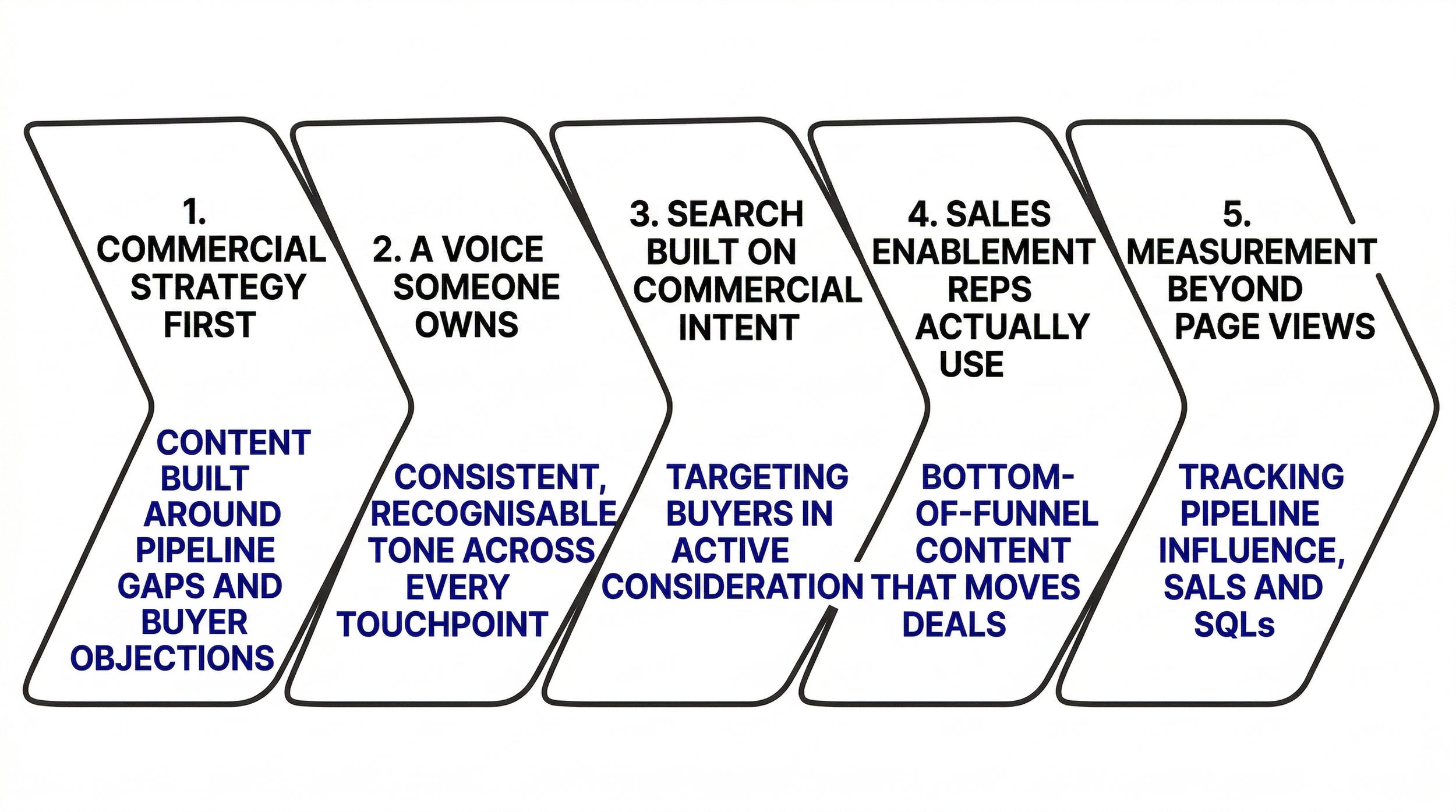
The good news is that a solid structure doesn’t need to be complicated. It doesn't require a big team or even a big budget; just five key things that need to be in place and properly connected.
Commercial strategy before anything else
This is the layer most teams skip, or at least rush past. Content planning tends to start with a brainstorm, but the better starting point is understanding where pipeline is slowing down. Look at what keeps coming up on sales calls. What objections stall deals? What does a potential buyer need to believe before they’ll even take a meeting? That’s where the useful work sits.
SEO and thought leadership absolutely have a role, but they come after this. They should be shaped by this information, not used as a substitute for it.
When I built the Gen Alpha cheat sheet at GWI (a gated, downloadable asset), it pulled in 32 sales-accepted leads from high-value target accounts in just the first couple of weeks, with a CPL below our average. That happened because the asset was designed around a specific commercial problem at a specific moment in our buying cycle, and the creative thinking came afterwards.
Do this: If someone pressed your content team on why each piece in the next quarter's calendar was created, could they give a commercial answer for most pieces? If "it felt like a relevant topic" keeps coming up as a reply, it’s a sign there’s a disconnect.
2. A voice someone owns
When nobody owns the voice, everyone improvises. The founder writes one way, the marketing team another. Freelancers make educated guesses, while sales is doing its own thing entirely.
To a buyer moving across multiple touchpoints, it can read like four different companies - and it’s that kind of inconsistency that raises red flags early on.
Proper voice guidance is more than just a list of adjectives. “Bold”, “human”, “innovative” don’t give anyone much to work with. What’s actually useful is clarity around decisions: what you’d say in a difficult situation, how you talk about competitors, what kind of humour lands and what doesn’t, and which industry phrases you'd never use. That’s what makes content feel recognisable, even without your logo on it.
Do this: Read your homepage, your last LinkedIn post, and a recent email from one of your nurture sequences. If they don't feel like they came from the same place, voice ownership needs addressing.
3. Search that's built around commercial intent
SEO often gets reduced to "we need more traffic" or "we should probably rank for this keyword”, but when search is working properly, it’s grounded in intent. It’s about understanding what your buyers are actually looking for when they're close to a buying decision, and making sure you show up there with something useful. That's a very different brief from writing content optimised for volume.
The distinction between someone researching a category and someone actively evaluating solutions matters enormously for what you create and how you write it. A piece chasing broad awareness traffic looks completely different to something designed to capture a buyer who already knows they have a problem and is now figuring out who to solve it with.
I saw this play out really clearly when I was creating content for Intigriti. I didn’t increase the ontent output at all, just shifted focus towards high-intent, lower-competition keywords. Within a quarter, blog traffic doubled - not because I was doing more, but because I was targeting the right things.
Do this: Look at the last ten blog posts published. How many target something a buyer in active consideration would actually search for?
4. Sales enablement that reps actually use
This is the layer a lot of marketing teams underinvest in, and the one sales teams will feel most when it’s missing.
Case studies, comparison pages, objection-handling content, data-backed reports - when this bottom of the funnel content is done properly, it makes sales conversations so much easier. Content stops being theoretical, and starts pulling its weight in live commercial situations.
Do this: Ask a few people from your sales team to show you the last piece of marketing content they sent to a prospect. If they struggle to name one, or they pull out something two years old, the sales enablement layer isn't working.
5. Measurement that goes beyond page views
Only tracking page views is a bit like counting how many proposals you sent without noting whether any of them converted. The number isn't meaningless, but it's not the number that matters.
For a content function connected to revenue, the metrics worth tracking are pipeline influence, SALs, SQLs, and engagement shifts that tie back to something the business actually cares about.
The real question is whether your content is moving deals forward, not just attracting attention.
Do this: Pick 3-4 metrics that directly connect content to pipeline (e.g. influenced pipeline, content touched by SQLs, or conversion rates on high-intent pages) then review them monthly alongside sales data, not in isolation. If you can’t clearly explain how your content is contributing to revenue, you’re either still measuring the wrong things, or the content isn’t working hard enough.
What this looks like when you put it into practice
Five layers might sound like a lot, but in practice, it comes down to three areas of ownership being clearly defined inside the team.
Someone has to own the strategy. That means being accountable for deciding what's actually worth creating, how the content calendar connects to commercial priorities, and what gets deprioritised when capacity is tight.
Someone has to own the execution. Once the strategy is clear, the work needs to be done consistently - writing, editing, optimising, building assets, updating priority pages. Where things tend to break down is when execution is separated from strategy. But when the two are properly joined up, briefing gets faster, and the output starts to feel like it's building on itself.
Someone has to own the feedback loop. This tends to take the back seat out of the three, but it's what keeps everything calibrated. Which assets are sales actually sending? What questions came up on calls last month that content isn't answering? A 30-minute check-in with sales once a month is often enough.
Who should own this?
There isn’t a single “right” model here - just trade-offs that are worth being clear on.
An in-house content manager gives you proximity and consistency, but in practice, the role often ends up skewing more towards either strategy or execution, depending on time and priorities. An agency brings capacity, but can struggle with the detail and specificity a single business needs; it's difficult to produce content that sounds native to a company when you're doing the same for eighteen others. Freelancers are usually great at getting the work done, but if the brief’s vague or the voice isn’t clear, they can end up taking more time to manage than you planned for.
The setup that tends to work well for scaling SaaS teams is a strategic partner who holds both the commercial thinking and the execution - someone who understands what content is supposed to do for the business, can shape what gets created, and then produces it to a consistent standard. It's the model that closes the gap between strategy and output without the overhead of a full-time senior hire.
But whatever model you're running, it’s always worth asking yourself if the person responsible for content output is also responsible for whether it performs. When those two things belong to different people with different priorities, that's where friction can pop up.
A self-assessment worth working through
If you've read this far and want to get a clearer picture of where your team currently sits, these questions are a useful starting point.
On strategy
Can you name the sales objections your content is currently addressing?
When did content last directly influence a deal, and do you know which piece it was?
Is your content calendar driven by commercial priorities, or by what seemed like good topics at the time?
On brand voice
Does your homepage sound like your LinkedIn? Does your LinkedIn sound like your sales emails?
If a new freelancer started tomorrow, could they write in your voice from day one without significant rework?
Is your voice documented anywhere, or does it mainly live in one person's head?
On search
Are your top-performing posts attracting the buyers you want, or just visitors?
Do you know which content pages are showing up in pipeline conversations?
Does the person running your SEO know what your buyers are actually worried about?
On sales enablement
When did a rep last send a piece of marketing content in a live sales conversation?
Do reps know what to send and when, or are they writing their own proof points from scratch?
Is there something useful for every major objection your buyers raise?
On measurement
Are you tracking pipeline influence, or mainly page views and download numbers?
When content underperforms, do you understand why?
On ownership
Can you name who owns strategy, who owns execution, and who owns the feedback loop?
If the same person owns all three, do they have the capacity to hold all of them properly?
Is the person creating content accountable for whether it performs?
When content starts pulling its weight
The teams where content really compounds are the ones where it’s been built to do a job.
A flagship report brings in visibility. That visibility turns into leads. Sales conversations surface the same objections again and again. Those objections feed into the next piece of content. Each thing builds on the last, and over time, it gets sharper.
That kind of momentum doesn’t come from publishing more. It comes from having the right foundations in place - a clear commercial reason behind what gets created, a consistent voice running through it, defined ownership, and a feedback loop that keeps everything grounded in what’s actually happening.
If your content feels busy but not clearly connected to growth, that’s usually the signal. It’s not that more needs to be created; it’s that the structure underneath it needs tightening. And once that’s in place, everything else gets easier.
If you’re thinking about how to get there, I’m always happy to talk it through.
FAQs
-
A B2B content function is the system behind your content - how decisions get made, what gets prioritised, how messaging stays consistent, and how content connects to revenue. It’s not just what you publish, but how it supports the business.
-
B2B SaaS teams should structure content around commercial priorities, not just output. That means aligning content with sales conversations, defining a clear voice, focusing on high-intent search, and creating content that can be used directly in the sales process.
-
Content that helps sales teams includes case studies, comparison pages, objection-handling content, and data-backed insights. The key is that reps know when to use it and can easily send it during real conversations.
-
Ownership depends on the team setup, but someone needs to be responsible for both direction and performance. When strategy, execution, and results sit with different people, content often becomes inconsistent and less effective.
-
A strong content strategy shows up in pipeline, not just traffic. You should be able to see content being used in sales conversations, influencing deals, and addressing real buyer concerns, not just generating page views.