How to create B2B content that sales teams actually use
Key takeaways
Publishing more content won’t fix a sales problem: clarity and commercial intent will.
The best B2B content maps to specific moments in the sales process.
Strong case studies replace opinion with proof - and proof closes deals.
When content has a defined job in the pipeline, sales teams reach for it automatically.
Marketing publishes. Sales shrugs. Everyone blames “alignment”.
It's one of the most common frustrations in B2B SaaS, and it plays out in the same way across so many companies (in my personal experience, anyway). The content team is working hard. The blog post is published. The case studies are live. And yet, when it comes to the actual conversations with actual prospects, the sales team will reach for the same old crusty pitch deck that hasn’t been updated since God knows when.
If your sales team isn't using your content, it's rarely because they're resistant - it might not feel that way, I know - but hear me out. It's usually because the content wasn't built for them in the first place.
The fix isn't publishing more. It's building what's known as sales enablement content: material designed not just to attract an audience, but to actively support revenue conversations. Done well, it becomes one of the most valuable assets a B2B SaaS business has. Done badly - or not done at all - it leaves sales to improvise, and marketing wondering why no one's reading their stuff.
Here's how to fix that.
What’s B2B sales enablement content?
Sales enablement content is content designed to support real revenue conversations. It doesn't just sit on your website looking polished - it actively earns its place in the sales process by helping someone close a deal. That could look like an objection-handling one-pager that gives sales a confident answer when a prospect pushes back. Data-backed reports that build credibility without a rep having to over-explain. A compelling case study that keeps deals moving when momentum stalls.
It's also one of the highest-impact investments a B2B SaaS business can make - companies with a solid sales enablement strategy see an 8% increase in quarterly revenue and a 49% win rate on forecasted deals. That's what happens when content is built around revenue, not just reach.
Why sales teams ignore marketing content
Let’s call a spade a spade: if Sales isn't using your content, it's probably not very useful to them.
That's not a dig at anyone's writing. It's a structural issue. Most B2B content gets built around keywords and editorial calendars rather than the conversations sales teams are actually having. It's designed to attract traffic, not to handle the objection that comes up on every third discovery call. It's written for a general audience rather than for the specific person who's three emails deep into a deal and needs something credible to send.
The result is content that's too generic to feel relevant, too abstract to feel convincing, or too hard to deploy when a rep needs it quickly. If it doesn’t make their job any easier, they're not going to use it - regardless of how many times it gets shared in the company Slack channel.
So what does useful actually look like?
Let’s get practical.
How to create B2B sales enablement content that gets used
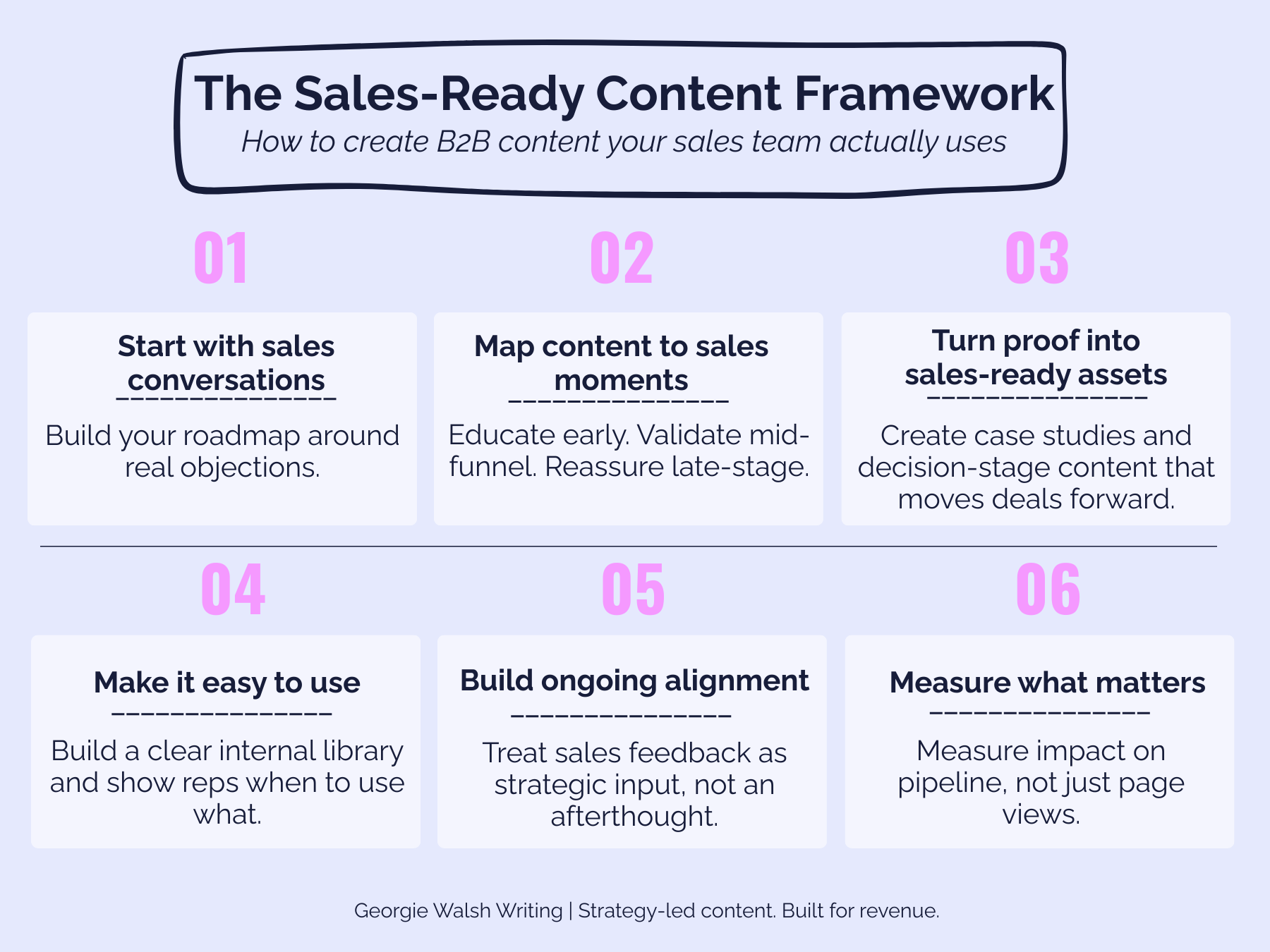
Step 1: Start with sales conversations, not content calendars
The best sales-ready content doesn’t start with a brief. It starts with a bit of digging.
Before you plan your next quarter of content, go and sit with your sales team. Pull call recordings. Scroll through deal threads. Ask what comes up in every demo - and then look for the repetition, because that's where the gold is.
Which objections stall deals?
Where does pipeline consistently slow down?
What does procurement always ask for?
If a prospect asks the same question three demos in a row, that’s a content opportunity. When content comes directly from those real friction points, sales will recognise it instantly. It feels specific, relevant, and like real support.
Step 2: Map content to the B2B sales process
Before you create something new, ask yourself, “Where exactly in the sales process will this be used?”
Early on, prospects need perspective. They're still shaping their view of the problem, working out whether they need help and whether you're worth listening to. Thought leadership and insight-led content does the job here - not to sell, but to educate.
Midway through, they need validation. They're interested, but they need evidence that you've done this before and that it works. This is where case studies, detailed use cases, and data-backed content earn their keep.
In the final stages of the funnel, they need confidence. This is objection-handling territory - honest answers to "why not hire in-house?", "why not use an agency?", or the one that comes up in most SaaS sales cycle right now: "why not just use AI?" Prospects here aren't looking for inspiration - they're looking for a reason to commit. Content at this stage should reduce risk. It should acknowledge trade-offs. It should make committing feel safe.
Ultimately, content should map to the buyer’s psychology. When you match the content to where a prospect actually is - offering perspective early, proof in the middle, and reassurance at the end - everything you produce has a real job to do.
Step 3: Use case studies as sales tools, not just marketing collateral
If there's one format that consistently earns its place in a sales process, it's a properly built case study. Not the thin, three-paragraph version that lives quietly on a website. The real thing, built around clear outcomes, specific data, and a story reps can actually use in live conversations.
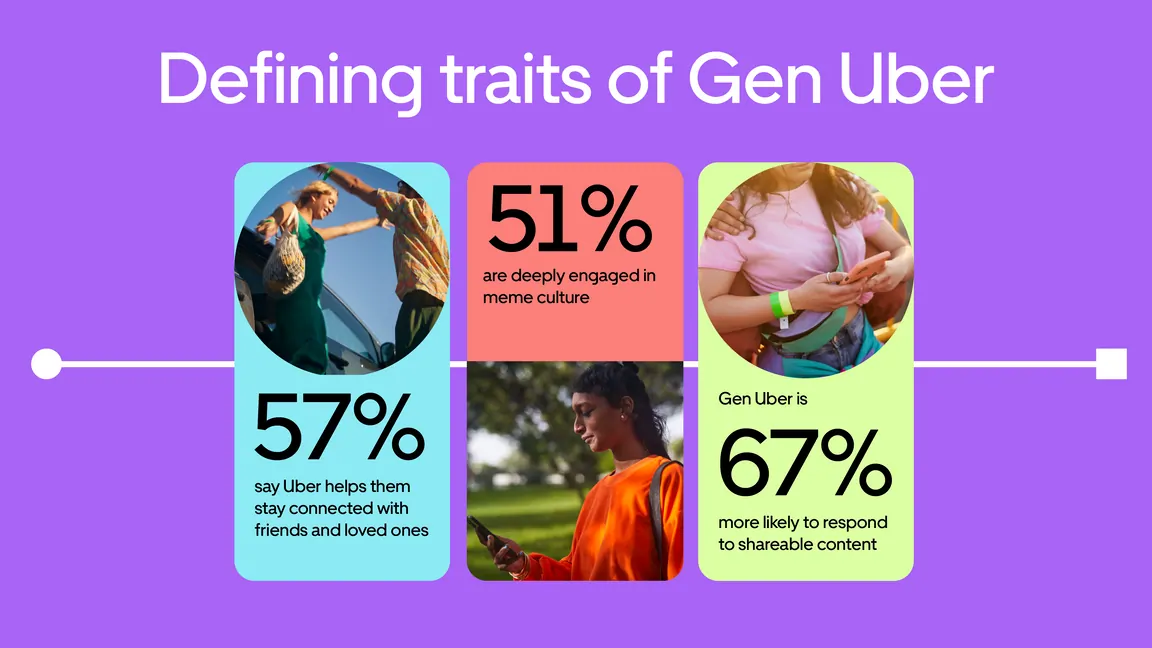
I saw this first-hand while working on a GWI case study with Uber Advertising, the division of Uber that sells its ad space to brands.
Uber Ads combined its own user data with GWI’s consumer research to create a detailed customer profile called "Gen Uber" - a fast-moving, on-demand audience that trusted the platform, moved quickly from discovery to decision, and was unusually receptive to advertising.
For Uber Ads, those insights made a seriously compelling argument for why brands should invest their ad budget on their platform. But for GWI, the case study became something even more valuable than a good story. It became proof.
Sales reps could walk into conversations and say, "We’ve helped Uber articulate the commercial value of their audience - and here's the data behind it." Not "we think we can help you." We've done this. For Uber. And here are the results.
The brand name carried weight, the data removed opinion from the room, and the story was specific enough that reps could retell it without losing the impact.
That's what a strong case study does; it gives sales something credible to stand on. And in B2B, credibility closes deals.
Step 4: Make it easy to use
Even the right content won't get used if it's hard to find or awkward to share. If a rep has to dig through folders, guess which version is current, or reformat something before they can send it, they won't bother. They'll default to the pitch deck. Every time.
Ask yourself:
Is there a clear internal library?
Are assets easy to link in follow-ups?
Do reps actually know what exists?
Is there guidance on when to send what?
Sales shouldn't have to work out how to use your content - that thinking should already be done for them. Even something as simple as a “When to Use This” section inside key assets can dramatically increase adoption.
“It always seems obvious to Content Marketers how our great content could help Sales and that leaves us frustrated when they don’t default to using it day to day. We forget that they don’t know the content as well as we do, or perhaps know when it will be most impactful.
The best way I’ve found to get rid of that disconnect is to use a content hub or tool that houses all your most up to date content. It should be easily searchable by theme and allow you to categorise by funnel stage. This clear signposting helps salespeople identify the right piece of content for every situation.”
Step 5: Align marketing and sales around content
Real alignment gets built into how content is planned, reviewed, and refined over time. That means regular conversations with reps, not just a kick-off and then silence. It means reviewing call recordings and flagging what keeps coming up. It means creating feedback loops so that when something lands well in a deal, that signal actually comes back to marketing - and when something isn't getting used, there's a way to find out why rather than just brushing it under the carpet.
If you’re not sure where to start, keep it simple: Put a recurring 30-minute 'Call Review' on the calendar once a fortnight. Don’t talk about brand guidelines or upcoming campaigns; just listen to a recording of a recent prospect call and ask the rep: “Which part of the deck did they actually pause on?” That’s exactly where your next piece of content lives.
The teams who do this well tend to have one thing in common: someone sitting between strategy and execution, thinking commercially as well as creatively. Ideally, that person treats content as a living system rather than a publishing schedule. If you already have that person in-house, brilliant. If not… well, I know where you can find one.
Step 6: Measure what actually matters
If your only metric is traffic, you'll end up optimising for the wrong thing entirely.
Sales enablement content isn't designed to go viral. It's designed to move deals forward, which means the results that matter are different. Instead of obsessing over page views, look at:
Which assets are shared in follow-ups
What content gets referenced on calls
Measurable impact on deal velocity
Direct feedback from reps
The most commercially valuable piece on your site might not be the highest-traffic page, but that’s fine. Its job isn’t reach, it’s revenue.
From content output to commercial impact
There’s a version of B2B content that exists to fill a calendar, and there’s a version that exists to move deals forward. The difference is intent.
When content is built around real objections, backed by proof, and designed for specific sales moments, it stops being "marketing output" and starts being commercial infrastructure. Sales teams don’t need to be convinced to use it; they reach for it automatically because it actually solves the problem in front of them.
If your sales team still defaults to the same old pitch deck, don’t see it as a failure. See it as feedback. It’s a signal that your content needs a clearer job, or a closer connection to the conversations actually happening in your pipeline.
When that connection clicks, the entire dynamic shifts: Marketing feels purposeful, Sales feels supported, and content finally earns its place at the centre of the deal.
If that’s the kind of system you’re trying to build, I’m always happy to talk it through.
FAQs
-
B2B sales enablement content is content designed to support revenue conversations, not just generate traffic. It includes case studies, objection-handling articles, comparison pages, and data-backed reports that sales teams can use directly in prospect discussions to build trust and move deals forward.
-
Sales teams ignore content when it isn’t built around real sales conversations. If content is too generic, too abstract, or not tied to common objections, reps won’t use it - no matter how well written it is.
-
Content that helps close deals includes detailed case studies, comparison pages (e.g. in-house vs agency), pricing transparency content, and objection-handling articles. These assets reduce risk and give sales something credible to reference during late-stage conversations.
-
Start with sales conversations. Review call recordings, identify repeated objections, and map content to real friction points in the pipeline. Alignment isn’t a one-off meeting - it’s an ongoing feedback loop between marketing and sales.
-
Not necessarily. Some content builds awareness and authority. But high-performing B2B teams deliberately create a portion of their content to support specific sales moments, especially mid- and late-stage conversations where proof and reassurance matter most.
-
Companies with structured sales enablement strategies consistently report higher win rates and measurable revenue growth. When sales has clear narratives, proof points, and objection-handling resources, deals move faster and close more predictably.